
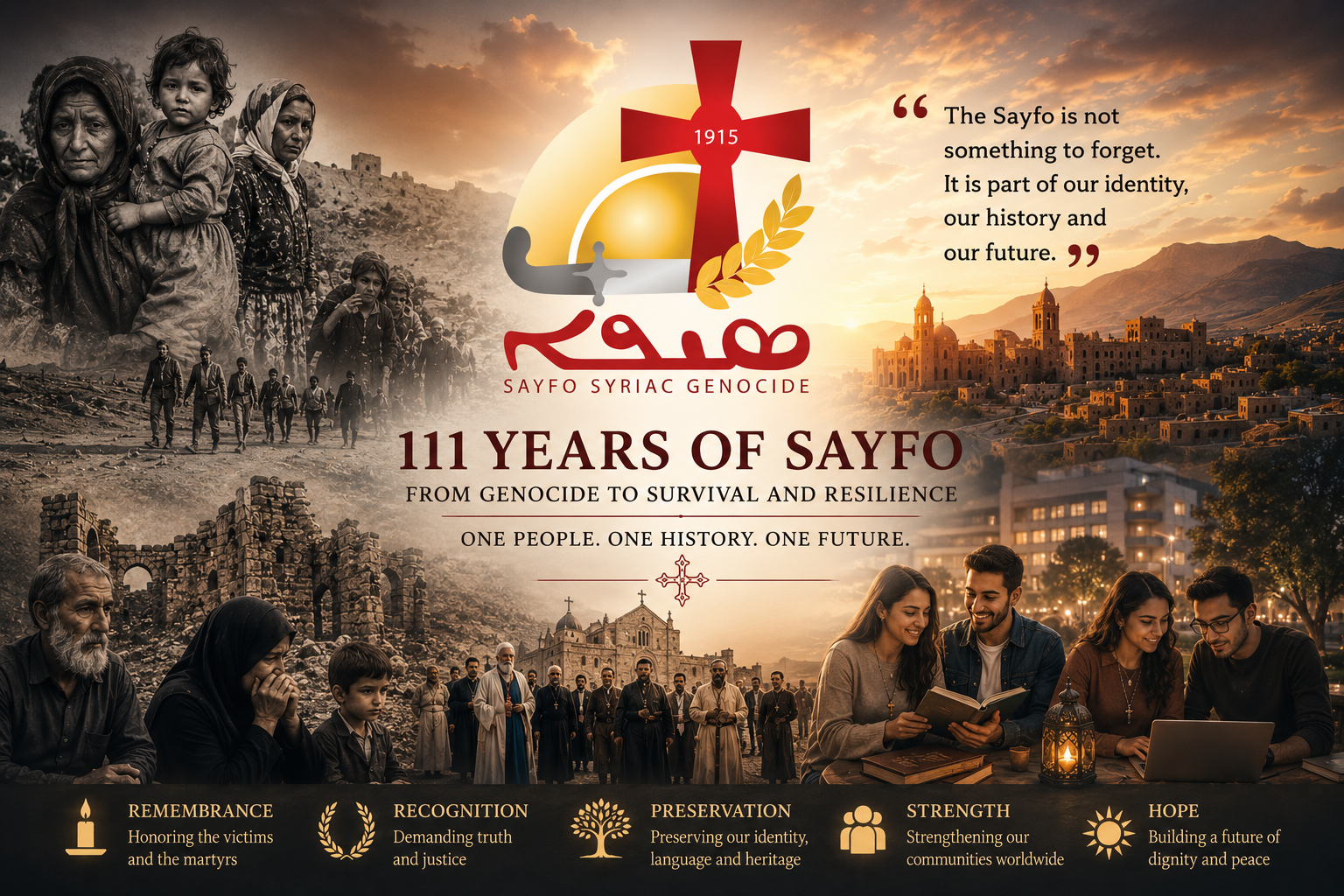
One hundred and eleven years after the Sayfo, the Syriac people continue not only to commemorate their dead but also to secure their future in the Middle East and throughout the diaspora. The genocide of 1915 was not merely an attack on Christians; it was an assault on one of the indigenous peoples of Mesopotamia, targeting their language, villages, churches, monasteries, collective memory, and political existence.
For the Syriac people, the Sayfo meant the destruction of entire ancestral regions, particularly in Tur Abdin, Hakkari, Urmia, Mardin, Diyarbakir, and other historic homelands. Countless survivors were displaced, dispossessed, or forced to flee. Churches and monasteries were destroyed, villages depopulated, and invaluable manuscripts and cultural treasures lost. The Sayfo remains the defining modern tragedy of the Syriac people and continues to shape their collective memory and identity.
Yet the story of the Syriac people did not end in 1915.
What followed was a century-long struggle for survival. Across Syria, Iraq, Lebanon, Turkey, Iran, and later Europe, North America, and Australia, Syriac communities rebuilt their lives from the ashes of destruction. They established new communities, preserved their language, strengthened their churches, founded political and cultural organizations, and defended their identity against assimilation, displacement, and silence.
For this reason, the Sayfo must never be trivialized. It is not enough to say that the Christian martyrs are now in paradise. While such statements may offer spiritual comfort, they must never obscure the historical and political reality of genocide. The Sayfo was more than a Christian tragedy. It was an attempt to erase an entire people from their homeland, their history, and their future.
History offers several comparable examples. The Armenian people suffered genocide within the Ottoman Empire, losing hundreds of thousands of lives and much of their historic presence. The Jewish people endured the Holocaust, one of the darkest chapters in human history. Yet the memory of the Holocaust did not end with mourning alone. It became the foundation for reconstruction, political self-determination, cultural renewal, and the protection of Jewish life and identity across the world.
The Syriac people have followed a similar path of resilience.
Despite genocide, persecution, forced migration, discrimination, and repeated waves of violence throughout the twentieth and twenty-first centuries, the Syriac people did not disappear. They established thriving communities throughout Europe, created media institutions, developed political organizations, invested in education, preserved their liturgical and spoken languages, and ensured that future generations would know who they are and where they come from.
This achievement should not be underestimated. Many believed that the Syriac people would gradually vanish under the pressures of history. Instead, they survived and adapted while maintaining a strong connection to their heritage.
Therefore, 111 years of Sayfo is not only about remembering what was lost. It is also about recognizing what has been preserved, rebuilt, and achieved despite overwhelming adversity. It is a testament to the determination of a people who refused to surrender their identity.
The future of the Syriac people depends on transforming memory into responsibility: responsibility for recognition, for justice, for cultural preservation, for political participation, and for creating conditions that allow Syriac communities to remain and flourish in their ancestral lands.
The Sayfo cannot simply be forgotten or left behind. It is inseparable from the identity, history, and political reality of the Syriac people. Anyone who wishes to understand the present and future of the Syriac people must first understand the events of 1915—not as a closed chapter of history, but as the beginning of an ongoing struggle for existence, dignity, recognition, and a secure future.
Today, 111 years later, the Syriac people stand as living proof that genocide can wound a nation, but it does not necessarily destroy its spirit. The continued existence of the Syriac people is itself a testament to resilience, perseverance, and hope. Their story is not only one of suffering—it is also one of survival, renewal, and an unwavering commitment to remain a people.

